
Services
What I do
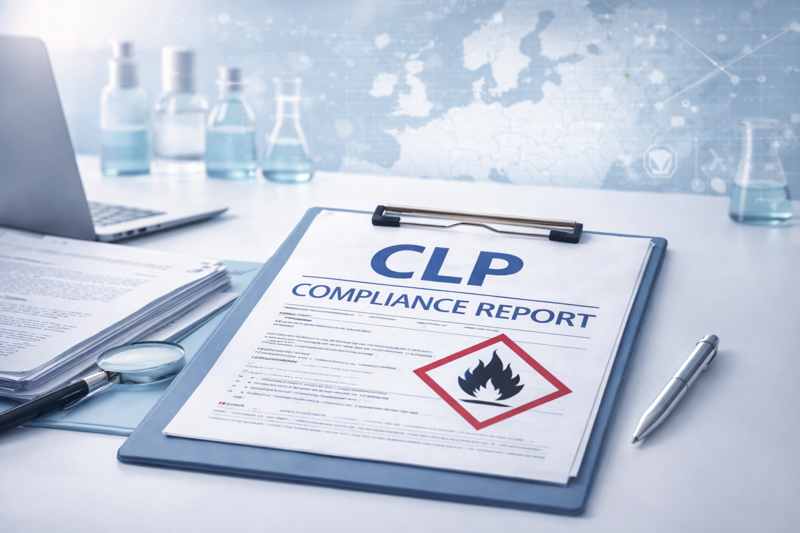
EU SDS, CLP Classification & Label Compliance
Defensible EU SDS, CLP classifications and label content
Placing chemical products on the EU market means accepting full legal responsibility under REACH and CLP. Safety Data Sheets (SDS), classifications, and label content must be correct, internally consistent, and defensible during inspections — not merely present.
We support companies, importers, and exporters with EU-compliant SDS, CLP classification, and regulatory label content that accurately reflect the formulation and intended use of the product. Our services include SDS authoring (translation) or review, verification of classification logic, and validation of all mandatory label elements. While we do not design graphic labels, we ensure that the regulatory content is complete, correct, and legally robust.
Regulatory logic, not assumptions
A SDS is a legal document under EU REACH and CLP and is relied upon by authorities, distributors, logistics partners, and online platforms to assess safety, transport relevance, and compliance. Errors or inconsistencies commonly lead to rejection, delays, or enforcement risk.
Our work follows EU regulatory precedence: classification determines the SDS and label content — never the other way around. We ensure alignment between CLP classification, SDS Sections 2, 3, and 14, and all regulatory label elements. The result is defensible documentation that meets EU legal requirements and commercial expectations, without over-classification, copied supplier data, or unchecked software outputs.
ADR Transport & Annual Safety Report Compliance
ADR annual safety reporting and transport compliance
Companies involved in the transport of dangerous goods by road may be required to appoint a Dangerous Goods Safety Adviser (DGSA) and to compile an annual ADR safety report in accordance with ADR Part 1.8.3. This obligation depends on the nature and scope of the company’s transport-related activities.
We support companies with a clear assessment of their ADR obligations and, where required, with the preparation of an ADR-compliant annual safety report, aligned with EU ADR requirements and enforcement practice.
Do you need a DGSA? Assessment before obligation
Not every company handling chemical products needs a DGSA or an annual ADR safety report. We start with a focused ADR gap analysis to determine whether ADR applies to your activities, which transport roles are relevant, and whether exemptions such as the 1000-points rule or Limited Quantities (LQ) can be used.
Where applicable, we assess packaging compliance under EU ADR requirements and prepare the annual safety report as required by ADR. Where not required, this is clearly documented. The outcome is practical certainty on whether a DGSA and annual reporting are needed — or confirmed justification when they are not.


EU Cosmetic Safety Assessment (CPSR · PIF · CPNP)
Scientifically sound cosmetic safety assessments
Under EU Cosmetic Regulation (EC) No 1223/2009, a cosmetic product may only be placed on the EU market if it is supported by a complete Cosmetic Product Safety Report (CPSR), a compliant Product Information File (PIF), and correct CPNP notification.
We support EU and non-EU cosmetic brands with clear, structured, and defensible safety assessments — aligned with EU law and grounded in scientific reasoning. Our focus is on proportionate compliance that meets legal requirements and holds up during inspections.
Regulatory discipline, not templates
Cosmetic safety assessment is not a box-ticking exercise. Each CPSR we prepare or review is based on SCCS guidance, ingredient-specific toxicological data, and realistic exposure scenarios, with transparent documentation of assumptions and uncertainties.
Our services include full CPSR preparation (Part A & Part B), independent CPSR review, PIF compilation and structuring, ingredient compliance screening, and CPNP notification support where mandated. All documentation is tailored to the actual formulation, product category, and target group.
All information can be submitted under a strict EU-valid Non-Disclosure Agreement (NDA).
The result is inspection-ready documentation that supports safe market entry, future reformulations, and regulatory confidence — without unnecessary regulatory burden.